









The development of renewable energy projects in Australia presents unique challenges that require careful navigation and strategic planning. This article will delve into the specific hurdles faced in the renewable energy sector in Australia and explore potential solutions.
High Project Volumes and Stakeholder Complexity
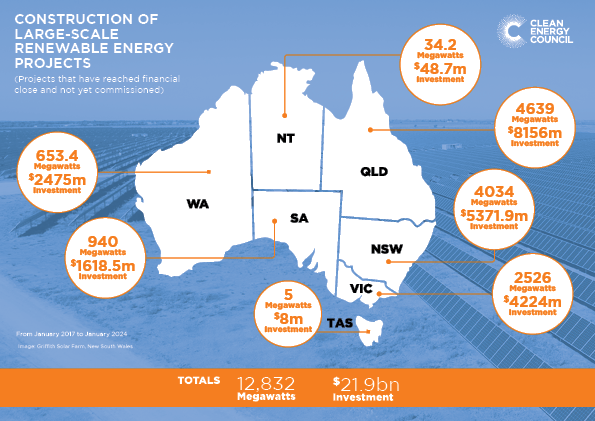
One of the most significant challenges in developing renewable energy projects in Australia is the high volume of projects currently underway or in development. The global goal to increase renewable energy capacity has led to an influx of projects. For instance, as of January 2024, Australia already had 12 gigawatts of projects in various stages of development, with a target to increase this to 30 gigawatts by 2030.
This surge in projects means more stakeholders are involved, ranging from local communities and landowners to government bodies and environmental groups. Additionally, the competition for access to transmission lines and Renewable Energy Zones (REZ) has intensified. Failing to secure a bid for a REZ may necessitate developing your own transmission line, significantly increasing project costs. Managing these stakeholders and complexities effectively requires a robust engagement strategy to ensure all voices are heard and concerns are addressed.
Faced with balancing such growth and community concerns, the government needed to promote renewable energy projects while ensuring they are implemented appropriately with local input. To address this, in July 2023, the “Community Engagement Review Report” was commissioned by the Minister for Climate Change and Energy to improve how communities and landholders are engaged in renewable energy projects. The report offered recommendations to streamline engagement processes so that project proponents could have clear guidelines on what could help and support project success, at least from a social approval point of view.
The recommendations were grouped under the 6 following themes:
- Developer performance and selection
- Selecting the best sites
- Reform environmental and planning approvals
- Complaint management.
- Messaging and governance
- Coordinated economic development and community benefits
These recommendations were designed to enhance community involvement, address past shortcomings in project rollouts, and ensure that renewable energy developments bring long-term economic and social benefits.
Regulatory and compliance challenges
Navigating the regulatory landscape for renewable energy projects in Australia is particularly complex, especially for offshore projects. These projects are subject to multiple layers of regulation at both Commonwealth and state levels, making compliance a critical aspect of project success.
Example of regulatory complexity: Offshore wind projects
The offshore renewables environmental approvals guidance, updated in collaboration with the Department of Climate Change, Energy, the Environment and Water (DCCEEW), highlights key licensing and approval steps for offshore projects. Activities that significantly impact Matters of National Environmental Significance (MNES) require assessment under the Environment Protection and Biodiversity Conservation Act 1999 (EPBC Act).
For offshore renewable energy projects, it is advisable to submit EPBC Act referrals only after the area has been declared and a feasibility licence has been granted under the Offshore Electricity Infrastructure Act 2021 (OEI Act). Additionally, before undertaking any feasibility activities, licence holders are required to submit a management plan to the Offshore Infrastructure Regulator.
The National Offshore Petroleum Safety and Environmental Management Authority (NOPSEMA) is another key Commonwealth entity involved in the regulatory process. NOPSEMA oversees the safety, well integrity, and environmental management of offshore petroleum and greenhouse gas storage activities. While its primary focus is on petroleum, its role in regulating environmental management is crucial for any offshore energy activities that intersect with these sectors.
Five key Commonwealth entities have a role in the regulatory processes for offshore projects:
- DCCEEW: Supports area identification and declaration, and implements the EPBC Act.
- Offshore Infrastructure Registrar: Administers licences.
- Offshore Infrastructure Regulator: Assesses management plans and oversees compliance.
- Director of National Parks (DNP): Protects Australian Marine Parks (AMPs) and requires authorisation for activities within these parks.
- NOPSEMA: Ensures that all environmental management practices meet stringent safety and environmental standards.
This complex framework requires developers to engage with various departments and comply with multiple regulations, ensuring their projects meet all necessary legal and environmental standards.
To help navigate the complex regulatory landscape effectively, diligent organisations should:
Engage early: Start by engaging early with the relevant departments. This proactive approach ensures you are well-informed and prepared for each step in the approval process.
Understand and adhere to expectations: Take the time to fully understand the expectations set by each regulatory body. Adhering to these guidelines will help your project stay on track and meet all necessary standards.
Ensure ongoing compliance: Maintain continuous compliance with all regulations throughout the project lifecycle. This practice helps avoid potential setbacks and ensures long-term project success.
Stakeholder fatigue and over-engagement
With numerous projects often concentrated in the same geographic areas, stakeholders can experience fatigue from being over-engaged. Stakeholders may be involved in multiple projects simultaneously, leading to confusion and frustration. For instance, landowners might receive numerous engagement requests from different developers, causing them to feel overwhelmed and less receptive to each new project.
To mitigate stakeholder fatigue, it is essential to coordinate engagements effectively. Within your organization but also with other, sometime overlapping or competing, infrastructure project in the area. This involves mapping out all ongoing projects and identifying overlapping stakeholders to streamline communications and avoid duplication. Clear, concise, and relevant communications help maintain stakeholder interest and cooperation. But this can hardly be done when the history of engagement with a stakeholder turns into a scavenger hunt because the information is scattered or worst, hidden in someone’s head.
Siloed teams and coordination issues
Internal coordination within project development teams is another significant challenge. Often, different departments such as legal, environmental, community engagement, and project management work in silos. This lack of coordination can result in conflicting messages being sent to stakeholders or important details being overlooked.
Using a centralized platforms like Borealis can help breaking down these silos to ensure a cohesive engagement strategy. As a result, teams collaborate more effectively, share information, and maintain a unified approach to stakeholder engagement.
Effective reporting and data management
Developers need to generate detailed reports on stakeholder engagements. These reports are essential for demonstrating compliance with regulatory requirements and providing transparency to stakeholders.
Developers need to track and report on various metrics, such as the number of engagements, the nature of communications, stakeholder feedback, and any grievances raised. Automated reporting tools can save time and reduce the risk of human error, ensuring that all necessary data is accurately captured and presented.
Again, this presents a big challenge for organisations that don’t work with a standardised platform where all engagement and stakeholder information are entered in a uniform way.
Geographic and environmental challenges
Australia’s diverse geography presents unique challenges for renewable energy projects. From the arid deserts to the lush rainforests, each region has distinct environmental considerations that must be addressed. For example, projects in Queensland may need to account for the Great Barrier Reef’s protection, while those close to the Murray-Darling basin might need to navigate water-scarcity challenges.
Environmental impact assessments (EIAs) are a critical part of the project development process. These assessments evaluate the potential environmental impacts of a project and propose mitigation measures to minimize negative effects. Engaging with environmental stakeholders early in the project can help identify potential issues and develop strategies to address them.
Indigenous land and cultural heritage
Australia’s Indigenous communities have a profound connection to the land, and their cultural heritage must be respected in any development project. Engaging with Indigenous stakeholders is crucial to understanding their concerns and ensuring that projects do not negatively impact their cultural heritage sites.
Across the globe, there is a growing recognition of the importance of incorporating traditional knowledge into various land-related projects. In Canada, for example, the government has developed the Indigenous Knowledge Policy Framework, which guides the inclusion of Indigenous knowledge in project reviews and regulatory decisions.
In the United States, under the Biden administration, a guidance document has been issued to federal agencies. This guide aims to foster and document Indigenous knowledge in federal research, policy, and decision-making processes, ensuring that Indigenous perspectives are integrated and respected across federal initiatives.
Therefore, developers must work closely with Indigenous communities to identify culturally significant areas and create management plans that protect these sites. Additionally, fostering genuine engagement and collaboration is crucial to developing a real partnership that benefits both Indigenous communities and the developers. This engagement process should be ongoing and adopt Free, Prior, and Informed Consent (FPIC) as a best practice framework.
Benefit sharing with the community
Sponsorship and community benefit funds are integral to renewable energy projects, particularly in Renewable Energy Zones (REZ). These benefit sharing programs help developers demonstrate their commitment to social outcomes, including financial compensation, community contributions, infrastructure development, or energy rebates. Efficiently tracking these commitments is crucial to proving to the government that all promises made during the consultation process are upheld but has been often identified as a challenge by project developers. Borealis software can significantly aid in this tracking, without external help since acts as a solid corporate memory for all projects across multiple teams. This helps ensure all commitments are met and documented effectively.
Economic and financial considerations
Economic factors, including financing and market conditions, play a crucial role in the development of renewable energy projects. Securing funding for large-scale projects can be challenging, particularly in a competitive market. Developers must present a compelling business case to attract investors and secure financial backing.
Government incentives and policies, such as the Renewable Energy Target (RET) and state-level feed-in tariffs, can also influence the economic viability of projects. Staying informed about policy changes and leveraging available incentives can help developers navigate the financial landscape.
Borealis offers a comprehensive set of solutions to renewable energy project development challenges
With 20 years of expertise, Borealis has developed a robust solution to address these challenges. Here are some of ways our software can help address some of the challenges seen above.
Smart Communications
Borealis enables users to send emails or letters to stakeholders efficiently. The platform tracks all communications, ensuring that no interaction is missed and that stakeholders are kept informed. This feature is particularly useful for initiating engagement processes and managing ongoing communications.
Mobile App
The Borealis mobile app allows project managers and field teams to manage communications and engagements on the go. The app supports offline mode, enabling users to record interactions even in remote areas without network access. Once connected, the data syncs with the main system, ensuring that all information is up to date.
Outlook Add-in
The Outlook add-in simplifies the process of categorizing and tracking emails. Users can select the project, engagement plan, and other relevant details directly from their email client, automatically creating a communication record in Borealis. This integration streamlines the workflow and ensures that all stakeholder interactions are documented.
Complaints management
Managing grievances is a crucial aspect of stakeholder engagement. Borealis provides a structured approach to track and address complaints, ensuring that all issues are resolved promptly and transparently. The Issue and complaint management platform also supports the creation of notifications and alerts if grievance resolution timelines are exceeded.
Stakeholder Profiles
Detailed stakeholder profiles in Borealis include contact details, recent communications, and related assets. This comprehensive view helps project managers understand the context of each stakeholder, facilitating more personalized and effective engagements.
Agreements Management
Borealis allows users to track and manage agreements, including payments and commitments. This feature ensures that all terms are met, and stakeholders receive timely updates on their agreements. The system also supports automatic calculation of payments based on predefined criteria.
Reporting and Analytics
Effective reporting is essential for regulatory compliance and internal coordination. Borealis offers robust reporting and analytics capabilities, allowing users to generate detailed reports on stakeholder engagements. These reports can be used to demonstrate compliance, inform project teams, and provide insights into engagement effectiveness.
Developing renewable energy projects in Australia involves navigating a complex web of challenges, from regulatory compliance and stakeholder engagement to geographic and technological considerations. Effective stakeholder management is crucial for overcoming these hurdles and ensuring project success. Therefore, software like Borealis aren’t just optional, good-to-have tools; they have become an essential industry standard that every renewable energy company must adopt to truly drive Australia’s renewable energy future.